Logistic Regression
Overview
Learn the fundamentals of Logistic Regression with step-by-step tutorials, video guides, and practical applications.
Definition
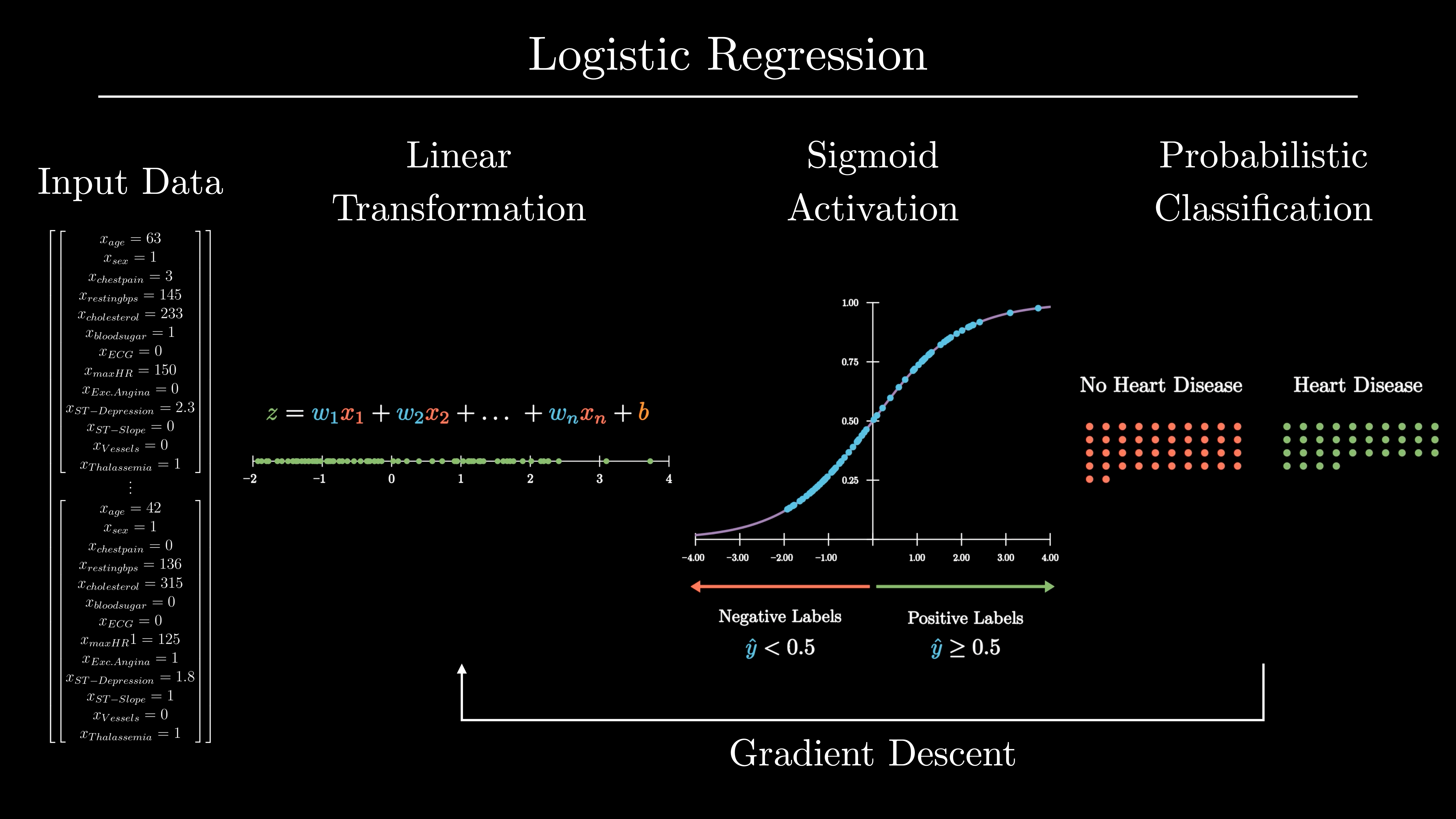
Logistic Regression is a supervised learning algorithm used for classification tasks. It models the probability that a given input belongs to a particular class using the logistic (sigmoid) function.
Types / Variants
- Binary Logistic Regression: Predicts one of two possible outcomes.
- Multinomial Logistic Regression: Predicts outcomes with more than two categories.
Key Concepts
- Sigmoid Function: Maps any real-valued number into the range [0,1] for probability interpretation.
- Log-Odds: Linear combination of input features transformed into probabilities via the sigmoid function.
- Decision Boundary: Threshold (commonly 0.5) used to classify outcomes.
- Loss Function: Uses cross-entropy (log loss) to evaluate model performance.
- Assumptions: Linear relationship between features and log-odds, independent errors, no multicollinearity.
Tutorials
- Logistic Regression Tutorial for Machine Learning
• Learn how to build, train, and evaluate a logistic regression model from scratch in Python using gradient descent.
- Step-by-Step Guide to Logistic Regression in Python
• Walk through loading the Breast Cancer dataset, fitting a LogisticRegression, and interpreting output with scikit-learn.
- Logistic Regression in Python – Real Python
• Hands-on coding: prepare data, train your model, tune hyperparameters, and plot decision boundaries.
Videos
• Pranit Pawar walks you through implementing logistic regression from scratch in Python, epoch by epoch.
• Code a logistic model on real data: fit, predict and evaluate using scikit-learn’s API.
• Keith Galli demonstrates how to load Iris data, train a KNeighborsClassifier, and plot decision boundaries.
Applications
- Medical diagnosis (e.g., predicting disease presence/absence).
- Credit scoring (e.g., approve or reject loan applications).
- Marketing campaigns (e.g., predict customer response: yes/no).
- Binary image classification tasks.
Resources
Tips & Best Practices
- Always check for multicollinearity among input features.
- Feature scaling is not strictly necessary but can help convergence in gradient descent.
- Use regularization (L1 or L2) to prevent overfitting in high-dimensional datasets.
- Interpret model coefficients in terms of log-odds or odds ratios.