Linear Regression
Overview
Learn the fundamentals of Linear Regression with step-by-step tutorials, video guides, and practical applications.
Definition
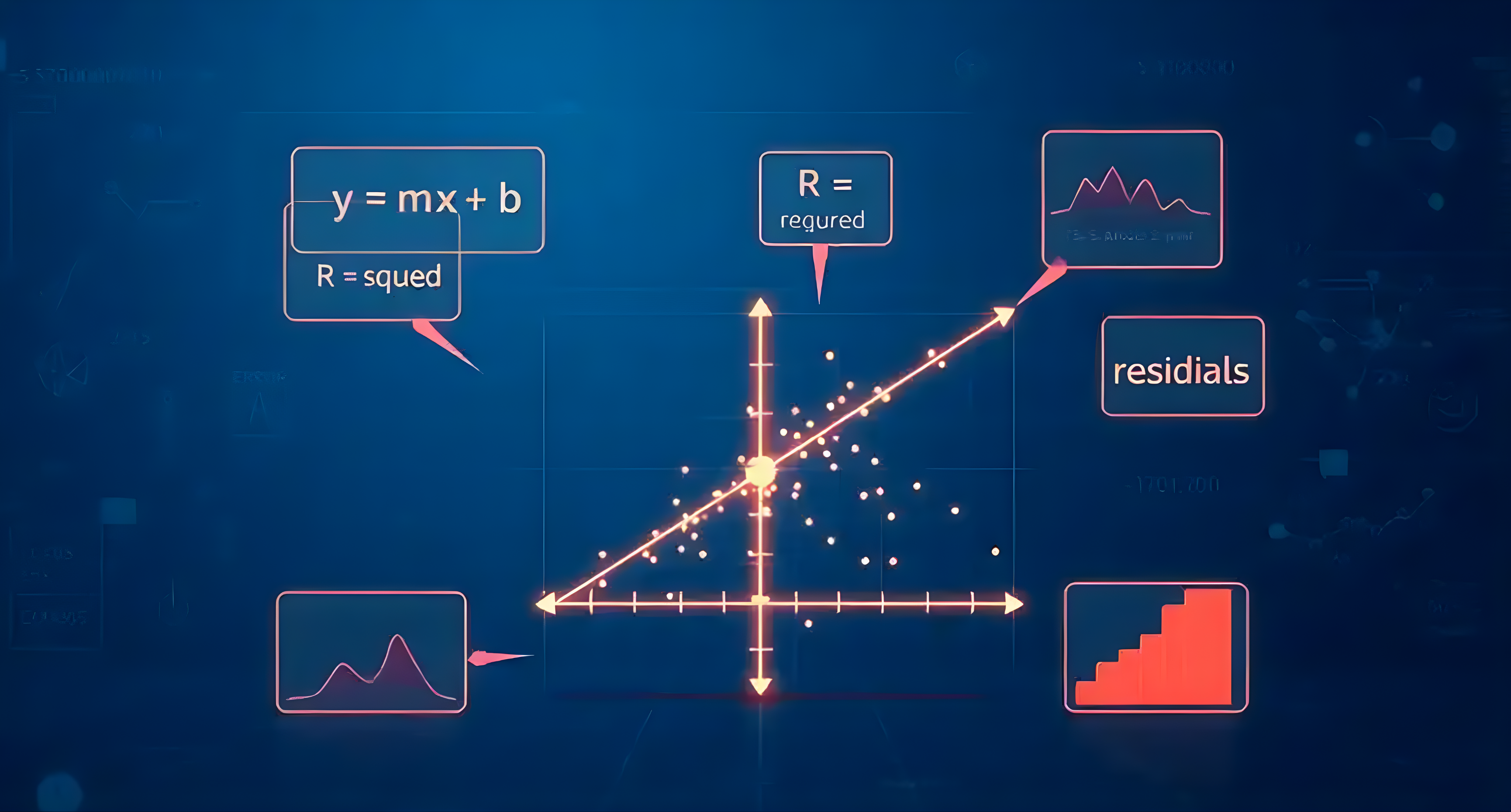
Linear Regression is a supervised learning algorithm used to model the relationship between a dependent variable (target) and one or more independent variables (features) by fitting a linear equation to observed data.
Types / Variants
- Simple Linear Regression: Models relationship between one feature and the target.
- Multiple Linear Regression: Models relationship between two or more features and the target.
Key Concepts
- Coefficient: Measures the impact of a feature on the target.
- Intercept: Value of the target when all features are zero.
- R² (R-squared): Indicates how well the model explains the variability of the target.
- Residuals: Differences between predicted and actual values.
- Assumptions: Linearity, independence, homoscedasticity, normality of errors.
Tutorials
- Introduction to Linear Regression
• Understand the goals of regression models and how linear equations form the foundation.
- Sklearn Linear Regression Guide
• Learn model fitting, evaluation metrics, and real-world examples using Python’s scikit-learn.
- Linear Regression with scikit-learn
• A beginner-friendly walkthrough with Python code and visualizations.
Videos
• A clear walkthrough of regression goals and how linear equations apply to real data.
• Foundational concepts explained with visuals and examples for beginners.
• Breaks down coefficients, R², and hypothesis testing in a simple visual style.
Applications
- Predicting housing prices based on features like size, location, and age.
- Sales forecasting for retail or e-commerce.
- Estimating student performance based on study hours and attendance.
- Analyzing business metrics like marketing spend vs. revenue.
Resources
Tips & Best Practices
- Always visualize data to check linearity before applying regression.
- Avoid multicollinearity; highly correlated features can distort coefficients.
- Check residuals to validate assumptions.
- Use feature scaling if your model includes variables with very different ranges.